Home/Home & Decor/Islamic Wall Art/Original Islamic Calligraphy Handmade Wall Art Islamic Gift Arabic Calligraphy Art Al-Mu'minun-109 Surah The Believers Verse-109 A6 010022
Etsy
Original Islamic Calligraphy Handmade Wall Art Islamic Gift Arabic Calligraphy Art Al-Mu'minun-109 Surah The Believers Verse-109 A6 010022
$199.00
In stock
Description
Handmade Original Islamic Art Calligraphy Handmade Wall Art Islamic Gift Arabic Calligraphy Art Al-Mu'minun-109, Surah The Believers Verse-109
Chapter 23. Al-Mu'minun
119 verses
اٰیاتھا 119
سُوْرَۃُ الْمُؤْمِنُوْنَ
Introduction: Al-Mu'minun
تعارف سورة المؤمنون
...
(Revealed before Hijrah)
Place and Date of Revelation
It can be said without fear of contradiction that the whole of this Surah was revealed at Mecca. All authorities including Qurtubi agree on this point. There seems to exist some difference of opinion about the exact number of verses of this Surah. The people of Basra regard it as 119. They count vv. 46 & 47 as two separate verses while the Kufis, who hold that these two verses constitute one verse, place the number of the verses of the Surah at 118. We, however, hold that the number of the verses including the Bismillah is 119. At any rate there appears to exist no ground for some Christian writers to discover a plea to impugn the authenticity of the text of the Quran on the basis of this slight difference of opinion. There is to be found complete unanimity among scholars that the whole text of the Quran as it exists today is the revealed Word of God and is completely immune from all human interference and interpolation. Thus, a seeming difference in the number of the verses of this Surah can cast no reflection on the reliability and authenticity of its text.
There is sufficient internal evidence to show that the Surah was revealed towards the end of the Holy Prophet’s stay at Mecca. Suyuti regards it as the last Surah to be revealed at Mecca while some other commentators assign its revelation to Medina. But not much weight is attached to this latter opinion. Wherry fixes sixth or seventh year of the Call as the time of its revelation. But the text of the Surah and Islamic traditions contradict Wherry’s assumption. The view however, seems to be more akin to reality that the Surah was revealed towards the end of the Meccan period, just before Hijrah, though actually it may not have been the last Surah to be revealed at Mecca as Sayuti thinks.
Connection with the Preceding Surah
In the closing verses of the last Surah the believers were told to turn to God and obey His commandments as in this lay the secret of their future progress and prosperity. They were also enjoined to wage war with the sword so that those who drew the sword against Islam should themselves perish by the sword. They were further enjoined to strive in the way of the Lord with the Quran. The alternative commandment of jihad sometimes with the sword and another time with the Quran has made provision for both the contingencies. Neither were non-Muslims compelled to accept Islam by force nor were believers required to accept any commandment against their conscience. The believers were further told that jihad with the Quran meant that they should observe Prayers and give the Zakah and hold fast to God and that if they acted upon these commandments, God would help them and vouchsafe to them success and prosperity. Whereas the closing verses of the preceding Surah had held out to the believers a conditional promise of success, in the present Surah a sure guarantee is given that a community of believers will certainly be born who, because they will fulfil the above-mentioned conditions, will achieve success. Thus a thing which was only presumed to have existed is claimed in this Surah to have come into being as an actual fact.
The subject matter of this Surah makes a little digression from that of the preceding few Surahs. Those Surahs contained a summary of the teaching of Christianity and rejected what was unacceptable in it and corrected and amended where corrections and amendments were found necessary. This Surah, too, embodies a repudiation of the false doctrines and teachings of Christianity, but at the same time makes a pointed and emphatic reference to the fact that the whole Christian system has been replaced by Islam, which by removing all interpolations and false ideas that had found their way into it, will now guide mankind to its destined goal.
Subject Matter
The Surah opens with the glad tidings to the true believers that the time of their success and prosperity has already arrived, and then proceeds to give a brief description of their characteristics and special marks, i.e. they worship their Lord with a humble heart; they refrain from all such actions as do no good to themselves or their community; they are ever ready to undergo all sorts of sacrifice for the sake of their country; they shut all those avenues through which evil thoughts find access to the human heart, particularly they guard their chastity; they faithfully discharge their responsibilities and fulfil their covenants and pledges with other peoples; they are specially regardful of congregational Prayers, i.e. they promote and foster national feelings among the members of their community and subordinate individual requirements to national needs. These are the people who will get the Paradise promised to them in this world and will enjoy God’s eternal and everlasting favours in the life to come.
This, in a nutshell, is the process of the spiritual growth and development of believers. It is followed by a brief but beautiful description of the growth of the human foetus and defines the different stages through which the child passes––from the stage of a drop of sperm to that of a fully developed human being. The Surah then proceeds to explain that just as every physical birth is followed by death and resurrection, similarly nations or communities among whom at one time a spiritual renaissance takes place, at another time are subject to decay and decadence and in due course are succeeded by another people. In fact spiritual and physical developments bear a close resemblance. Both of them have to pass through seven stages of development. Next, the Surah develops the theme, viz. that all things are sent down into the world according to a determined measure and each continues to exist and is afforded protection till an appointed time. When at last it has served its purpose it decays and dies. In the same way the Divine teachings, sent down before the Quran, died when they had served their intended purpose. Thus the mere fact of a teaching being Divine does not entitle it to immunity from decay. It is only the Quran which has been granted continuity of life and which will therefore provide spiritual food to all humanity for all time, because it is the last revealed Divine Law.
The Surah then recounts some of the favours which God has bestowed upon man and which are necessary for his physical sustenance, and draws the moral lesson that when God has taken so much care to provide for man’s physical needs, He must have taken equal, even greater, care to provide for his spiritual requirements.
Next, we are told that the most essential prerequisite to ensure spiritual progress is belief in the Unity of God which since the inception of the world the Prophets of God have taught and preached. But the enemies of truth have always protested that some superhuman being should have been sent by God for their guidance, but in spite of this persistent protest of disbelievers God has always commissioned only men to guide men, who in the face of determined and organized opposition and persecution succeeded in their mission. (It is a strange irony that before the advent of Jesus the disbelievers always demanded that a superhuman being, preferably an angel, should have been sent as a messenger of God to guide them. How a mere mortal like them, they said, could arrogate to himself the position of being a Divine Messenger. In the time of Jesus, when he metaphorically said that he was a Son of God, they said that it was highly preposterous and blasphemous for a mere human being to claim to be a Son of God, and in the time of the Holy Prophet disbelievers said that a Prophet could not come from outside the House of Israel. In fact man in his perversity and waywardness always has found some foolish excuse to reject God’s message).
The Surah then deals at length with the subject of Divine Unity and says that Noah preached and propagated the Oneness of God. After Noah came a galaxy of Prophets. All of them taught that God was One and those Divine teachers who came after them also emphasized and stressed it. The devotees of darkness, however, always opposed and persecuted the Prophets. The result of the struggle between truth and falsehood invariably was that the believers were successful and those who disbelieved and rejected the Divine Messengers suffered defeat and came to grief. Then we are told that in course of time came Moses, the greatest Prophet of Israel, with Aaron his brother as his deputy, and they both gave the same teaching and were also successful in their mission. This is a phenomenon which has occurred again and again in the lives of God’s great Messengers. From this it is quite clear that Unity of God is the basic doctrine of all religions which all Divine Messengers taught and upon which they laid the greatest stress. The Surah further says that towards the end of the Mosaic Dispensation came Jesus, son of Mary. He also taught and laid very great stress on the Unity of God but his followers invented the false doctrine of his sonship. Such a foolish doctrine, however, cannot be accepted as true against the combined testimony and teachings of all Divine Prophets, including Jesus himself. Next, the Holy Prophet Muhammad is enjoined to observe ordinances and commandments of the Shari‘ah like all other Prophets in the matter of food and in all other acts and to adapt and mould himself to God’s perfect Shari‘ah, because those who give up the right path are led away from Him.
The Surah then proceeds to say that there have always existed differences among the followers of all religions but these differences are the result of lack of true knowledge and of heedlessness which takes hold of men after their Prophets leave the world. But such is not the case with true believers. They fear their Lord and believe in His signs and have firm faith in His Unity and do good deeds to the best of their power, and yet consider themselves not to have fully discharged their duties and responsibilities. They strive to vie with one another in doing good deeds. Man, however, is expected to act only to the best of his powers because "Allah does not burden any soul beyond its capacity." Then it is stated that though the Law of God is quite practical and practicable, the disbelievers refuse to act upon it and in their perversity and the pride of their power and wealth continue to indulge in luxury and vain pursuits till God’s punishment overtakes them and they weep and wail, but then it is too late and their wailing and weeping is of no avail. They defy and reject Divine Messengers and call them madmen. But they are so foolish as not to understand this simple thing that if the Prophets had been madmen, they should not have succeeded in their missions but should have come to an ignominious end. On the contrary, all what they say and claim comes to pass. The fact is that in their heart of hearts disbelievers do not regard the Prophets as maniacs and madmen, on the contrary they entertain a creeping fear lest what the Prophets say may be fulfilled and they may be brought to book for their rejection of the Divine Message.
The Surah further says that God would have forgiven the transgressions of disbelievers but they have gone so far in mischief and iniquity that God’s forgiveness would not be of any use to them but would only add to their wickedness. If the disbelievers should only reflect a little they would find that the very structure of the human body bears a strong testimony to the truth of God’s Prophets and His Law and to the fact that there is only One Creator and One Controller of the whole universe and of every individual being, and yet they would not believe in Divine Unity. The truth is that God has no son, neither has He a partner in creating or controlling the universe. If He had one, the consummate and beautiful arrangement and order that pervades and permeates it would have gone to pieces.
Towards the end of the Surah disbelievers are warned that they will be punished if they persisted in their rejection of the Divine Message, and the Holy Prophet is told that as punishment is sure to overtake disbelievers he should pray that at that dreadful hour he might be away from the scene of their destruction. He is further told that disbelievers would not desist from their evil course and would continue to indulge in iniquitous deeds till when the hour of punishment arrived they will beg and beseech that they might be granted one last opportunity to reform themselves. But then it would be too late, and they will realize that pain and punishment after a life of ease and comfort is doubly mortifying. In fact a single day of punishment appears to be much longer than a whole life of comfort and ease. The Surah ends with stating the great spiritual truth that man is not created without a purpose. His life has a noble aim. He should not therefore doubt or dispute the truth of Divine Law and of God’s Messengers and should realize that after the truth is made manifest he will have to render an account of his deeds to his Lord if he did not desist from the worship of false gods.
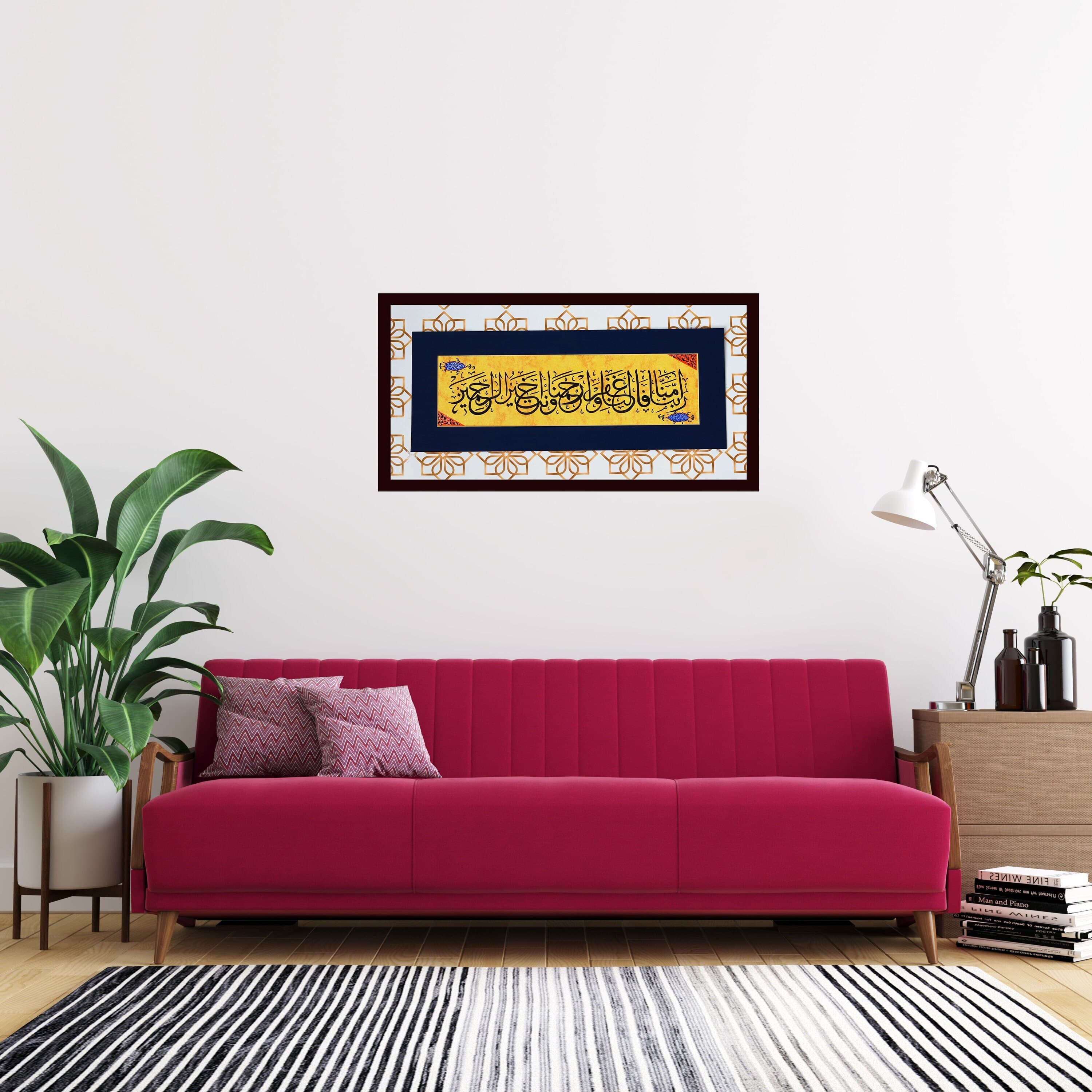
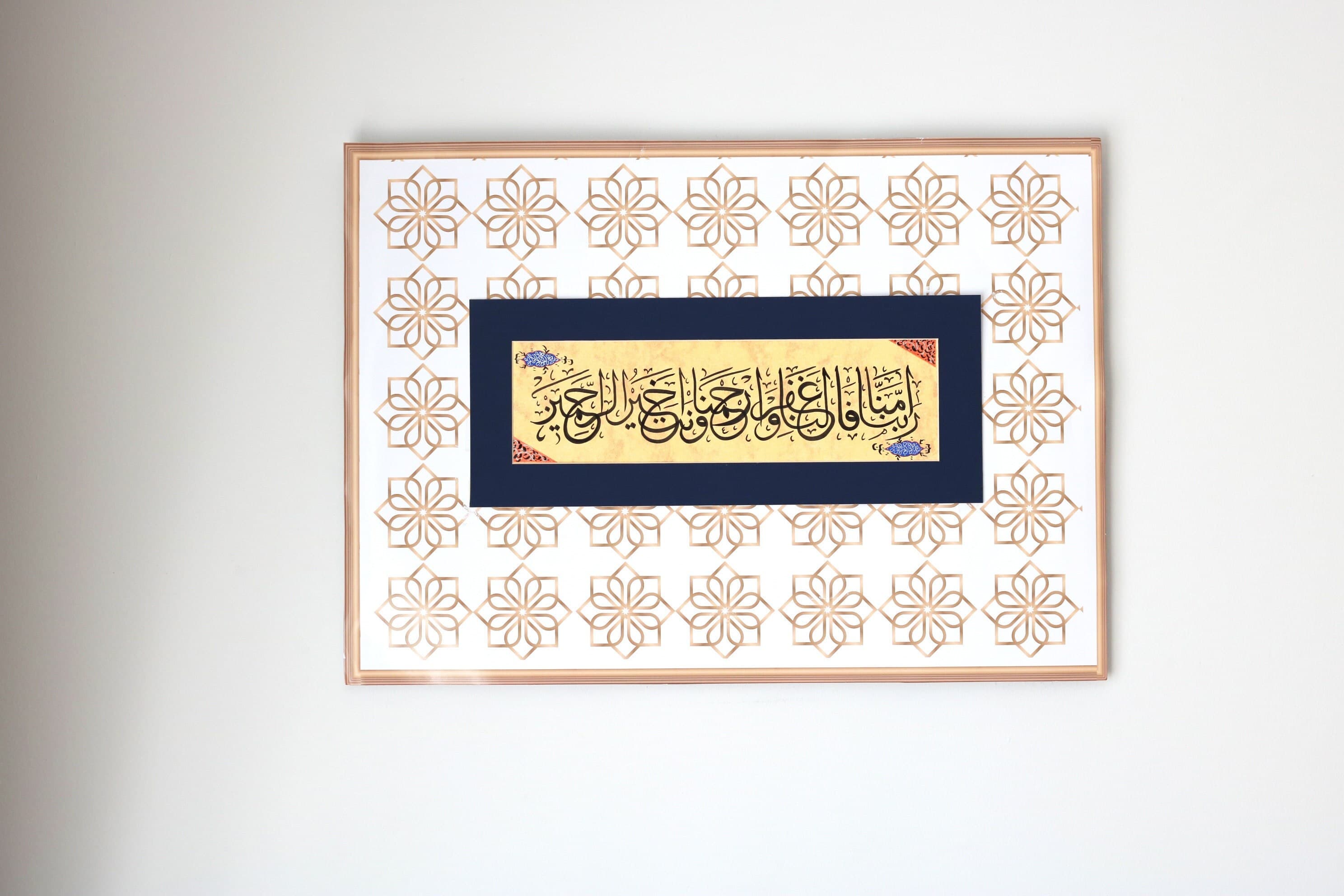
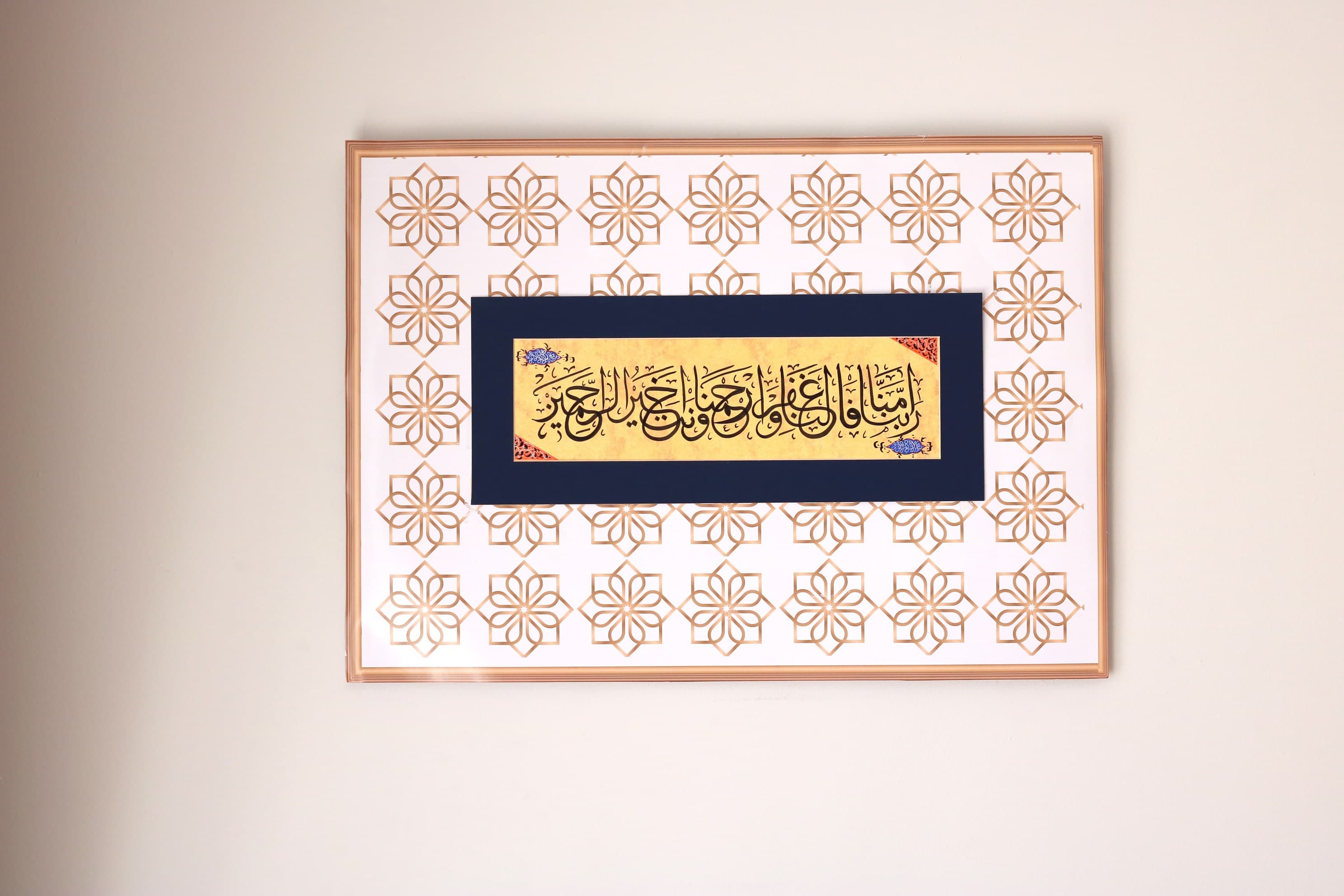
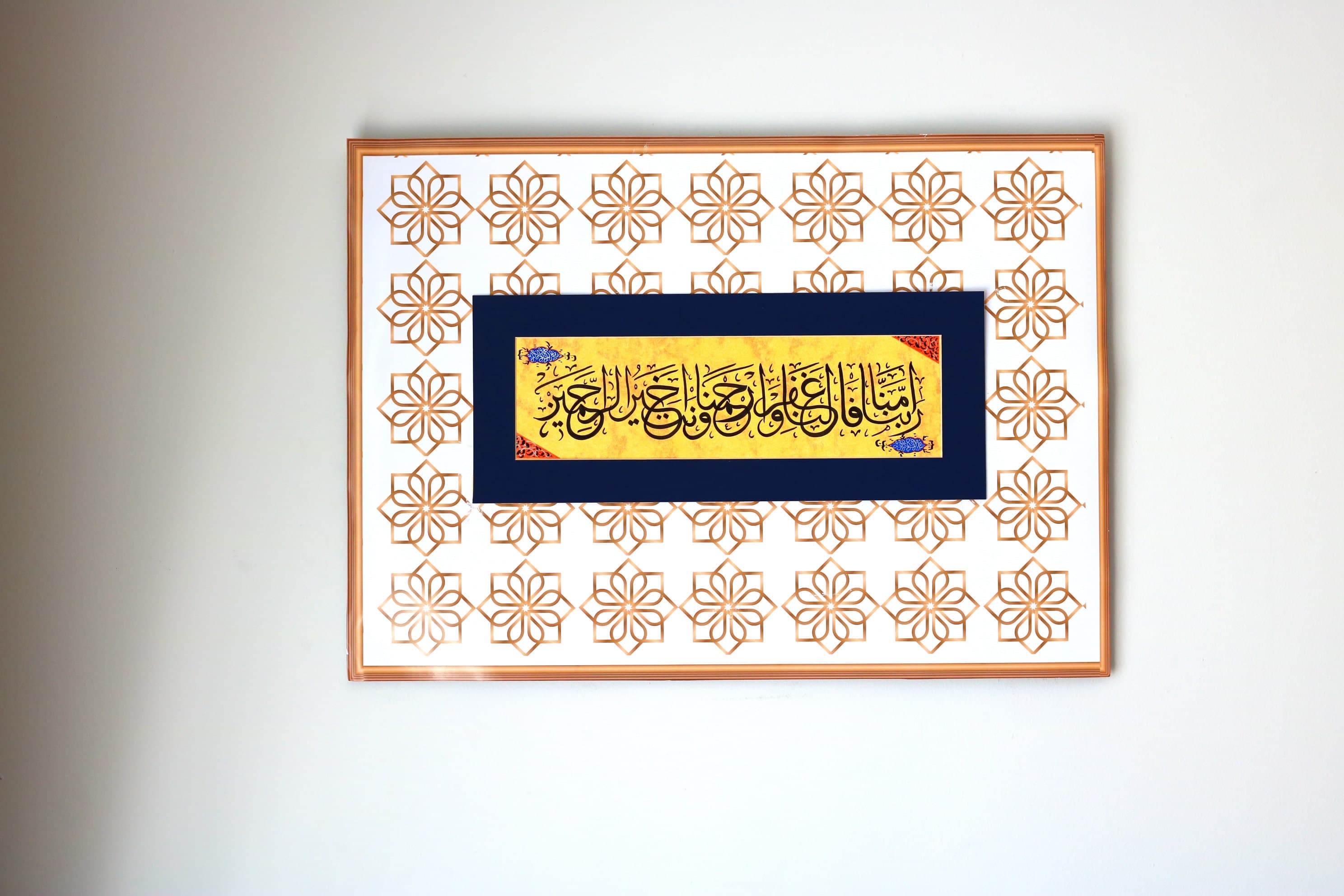
The Islamic Calligraphy Work of Art includes the Arabic calligraphy handwriting of
Al-Mu'minun-109, Surah The Believers Verse-109
بسم الله الرحمن الرحيم
رَبَّنَا آمَنَّا فَاغْفِرْ لَنَا وَارْحَمْنَا وَأَنتَ خَيْرُ الرَّاحِمِينَ
In the name of Allah, the Beneficent, the Merciful.
Surely a party of my servants say: “Our Lord! We believed (We wished to reach You before death) so forgive us and have mercy on us (Manifest upon us with Your Most Merciful attribute) and you are the Best of the Merciful.
This painting is an outstanding piece of art. It is a special handmade / hand painting item. The listing does not include any digital printing items. The painting is made over 200 gr special calligraphy paper.
The seizes of the work are;
Unframed seizes
40.5 cm x 12.5 cm / 15.94” x 4.92”
Please keep in mind that there could be some slight differences in colours due to the light effect, the video of the listing will show its original colour of paper and writing. The mat around the calligraphy and the designed background is only for decoration, it is not included in the listing. The listing covers the handmade / handwritten Islamic Calligraphy special paper in its mentioned seizes.
The painting is well packed and under the guarantee of Original Islamic Calligraphy Handmade Anatolian Arts until the arrival at your address.
The item will be shipped once the payment process is completed. The shipping time is within 5 days (generally 3) within Europe and US.
You are responsible for all duty, customs or VAT charges, or any other charges imposed by your country. Please check with your customs office to determine the amount you could be charged before placing order.
All of my pieces are wellpacked to ensure their safe arrival. I will gladly replace or refund any item that should be broken or lost in transit.
All of our Handmade Hand Gemachte products are under the gurantee of Original Islamic Calligraphy Handmade Anatolian Arts. For any reason of disapproving the item, you are kindly asked to ship the item back. The shipping cost shall be covered by the buyer.
Please feel free to ask me any questions you may have in advance of purchase
Islamische Art, Islamic Art, Calligraphy Islamic, Wall Art, Wall Decor, Wall Decoration, ISlamic Wall Art, Islamische Wall Art, Spiritual Art, Modern Art, Arabic Wall Art, Trendy Wall Art, Wall Hanging, Home Decoration, Islamic Painting, Bedroom Wall Art, Islam, Quran, Home Gift, Ramadan Decor, Framework Wall Art, Living Room Decor, Eid Gifts
More in Islamic Wall Art
View all
Islamic wall art/Islamic calligraphy poster/Light upon Light modern abstract Islamic art/Islamic gift ideas/Muslim home decor/Arabic poster.
€9.12
Pink Islamic Wall Art: Floral Quran, Feminine Gifts, Housewarming, Nikkah, Arabic Calligraphy
£11.99
Personalized Cherry Blossom Wall Art Set - Pink Floral Decor for Girl's Room, Custom Name Nursery Prints, Butterfly and Flower Nursery Art
$15.00

It Never Gets Easier You Just Get Stronger Wall Decal – Gym Quote Sticker – Fitness Motivation Vinyl – Home Gym Decor – Workout Inspiration
£28.00
Metal Surah Ar-Ra'd İslamic Wall Art, İslamic Wall Art, Muslim Wall Art, Quran Wall Art, Arabic Wall Art,İslamic Art,İslamic Gifts,Eid Gifts
$120.92
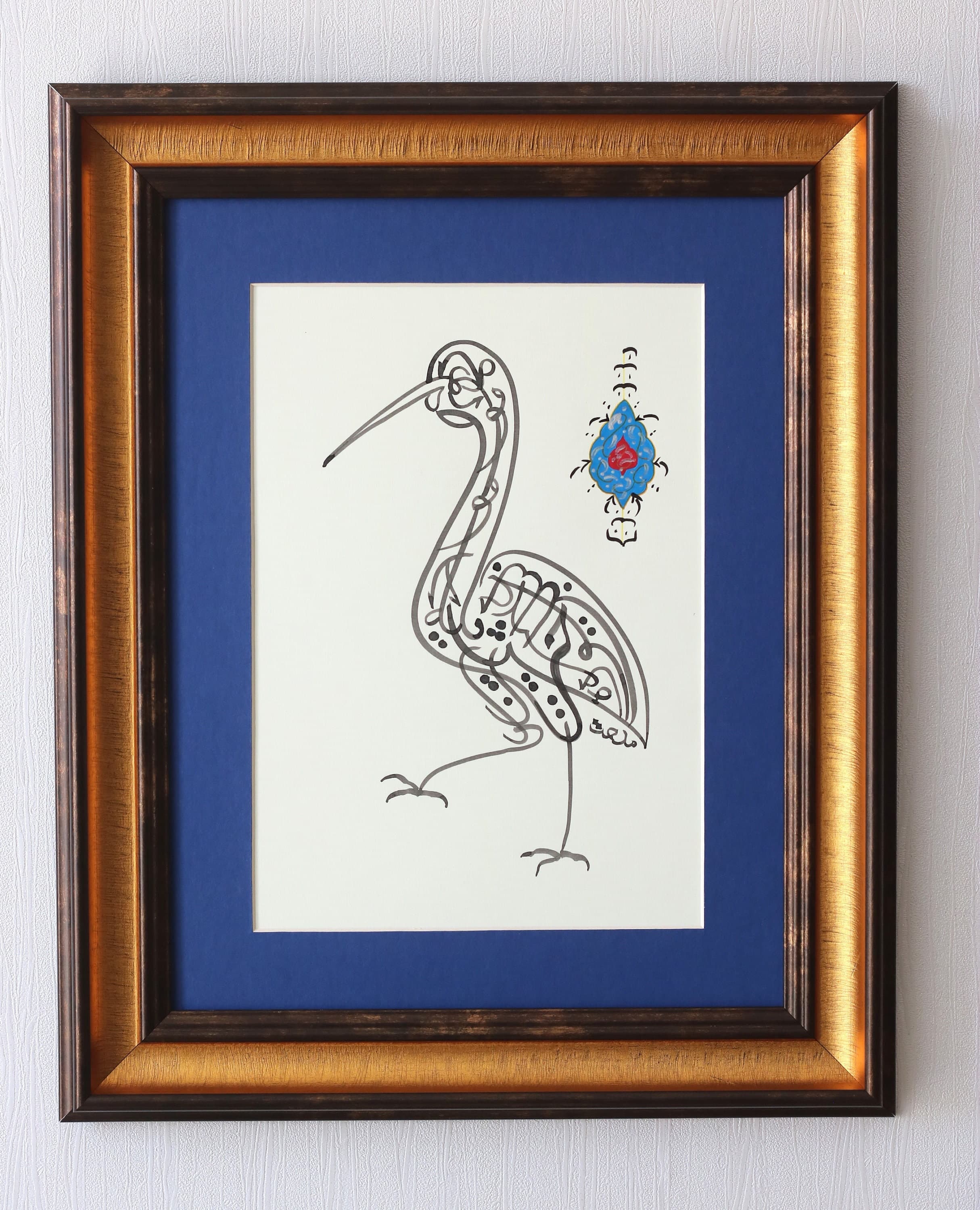
Handmade Framed Islamic Calligraphy Art, Bismillah Basmala Art
$89.00
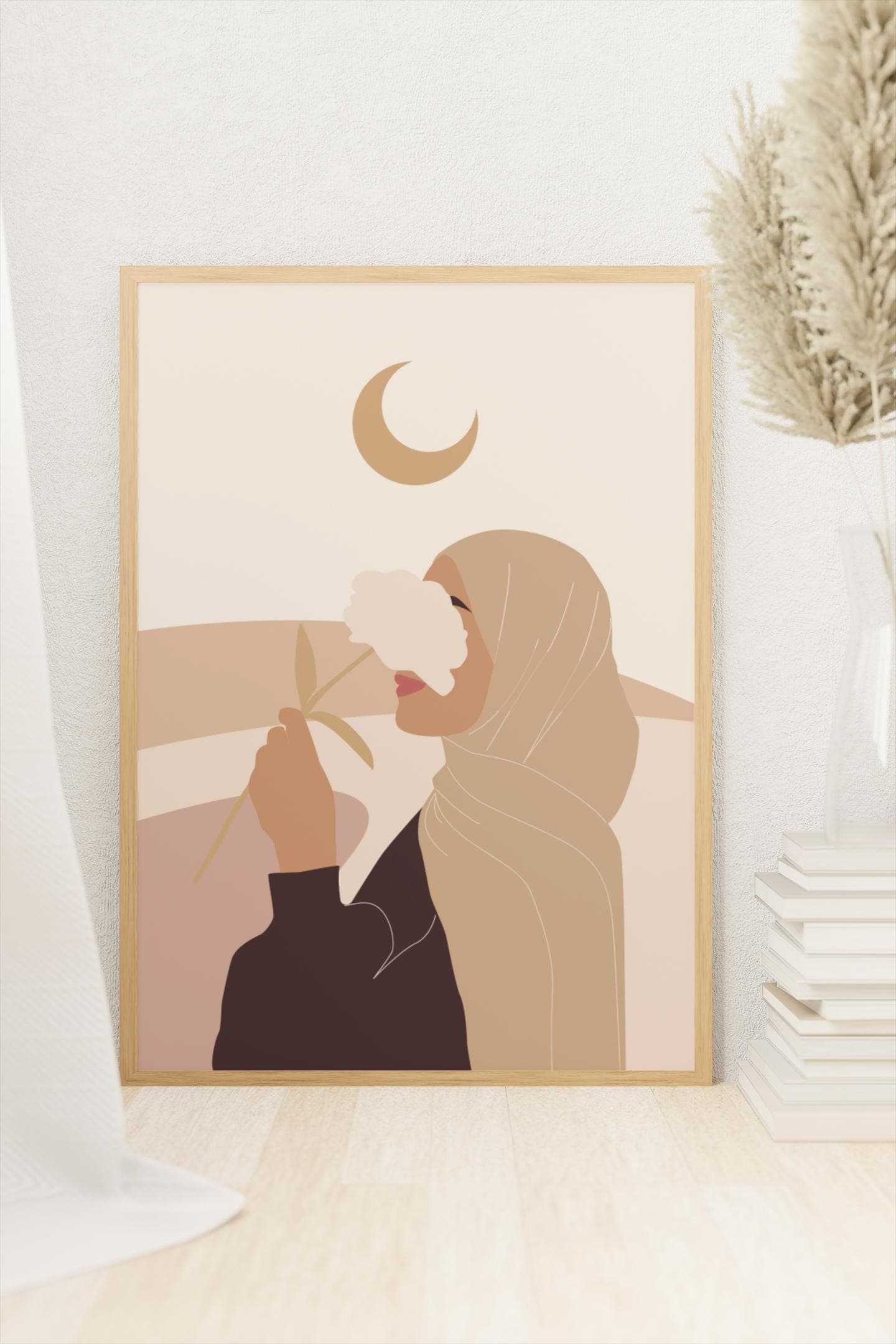
Hijab Wall Art Print – Boho Crescent Moon Muslim Illustration, Scandi Minimalist Decor A3
£14.99
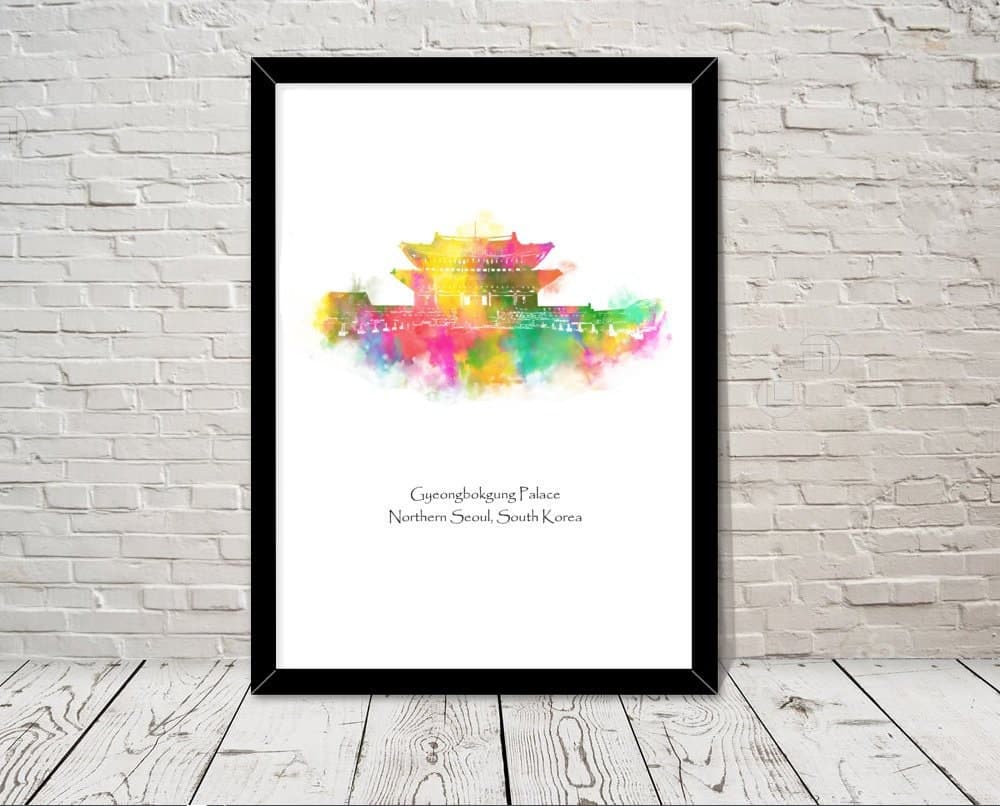
Gyeongbokgung Palace South Korea Watercolour illustration Print World Landmarks Attractions Famous Landmark Travel Poster historical sites
£8.00